Curves
The main object used by this library is the Curve. It allows representing Bezier, BSplines and Rational BSplines by the same class. You find a simple example bellow with a curve of degree 2 and 4
import numpy as np
from matplotlib import pyplot as plt
from compmec.nurbs import GeneratorKnotVector, Curve

# Define curve
knotvector = GeneratorKnotVector.uniform(degree = 2, npts = 4)
curve = Curve(knotvector)
ctrlpoints = [(2, 4), (1, 1), (3, 2), (0, 3)]
curve.ctrlpoints = np.array(ctrlpoints)

# Plot curve
uplot = np.linspace(0, 1, 129)
points = curve(uplot)  # shape (129, 2)
xplot = [point[0] for point in points]
yplot = [point[1] for point in points]
plt.plot(xplot, yplot, color="b")
xvertices = [point[0] for point in ctrlpoints]
yvertices = [point[1] for point in ctrlpoints]
plt.plot(xvertices, yvertices, marker=".", ls="dotted", color="r")
plt.grid()
plt.show()
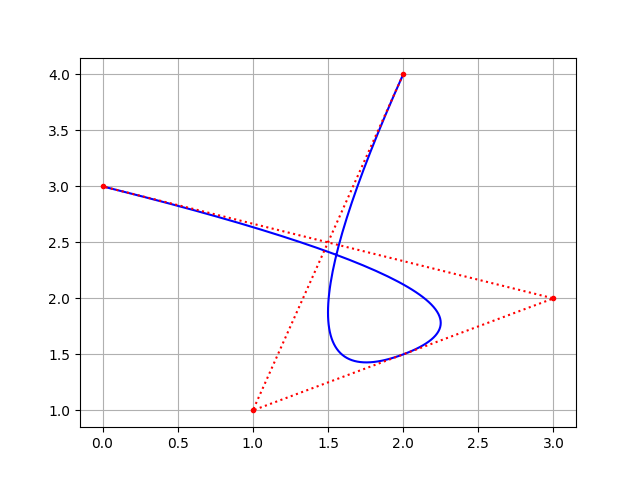
You can also create your own custom knotvector by passing a list of custom values. For example, take fractional knots.
from fractions import Fraction
from compmec.nurbs import KnotVector
zero, half, one = Fraction(0), Fraction(1, 2), Fraction(1)

vector = [zero, zero, half, one, one]
knotvector = KnotVector(vector)
print(knotvector.degree)  # 1
print(knotvector.npts)  # 3